
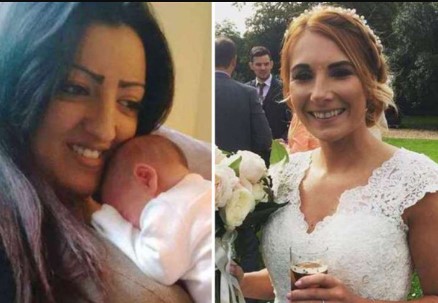
Mid Kent and Medway Coroners are investigating the cases of Kimberley Sampson, 29, and Samantha Mulcahy, 32, who died in 2018 after the same obstetrician performed a cesarean section on them. No tests were done that could have helped to see if someone on a medical team caring for two women who died of herpes had the virus, an investigation has heard.
They were treated seven weeks apart at hospitals run by the East Kent Hospitals University NHS Trust (EKHUT). Both died of herpes shortly after giving birth and their families, who were in the audience, have been waiting for answers for almost five years.
The inquest in Maidstone, Kent, into their deaths, heard that taking nasal and oral swabs might have been helpful, but this did not happen. Professor Richard Tedder was an external consultant hired through Public Health England who attended a meeting with members of the trust in July 2018.
Kimberley Sampson and Samantha Mulcahy Cause of Death
Professor Tedder said: “I think I would like to be pretty sure that the team felt they had been investigated and cleared of any responsibility for causing that and that it would be a very important infection control action with the trust.”
He said he believes the screening would have been his advice in 2018, adding that “that’s what I would suggest at the time and not because I wanted to blame anyone.” Professor Tedder told the inquiry that “in my view, the two unfortunate cases are unique in my 40-plus years of medical virology” and “it’s devastating, but it’s a very rare phenomenon.”
He suggested that research should look at whether the virus in women could be genetically related. Professor Tedder told the hearing that it was not possible to separate the two viruses and say that they did not come from a common source.
Ms. Sampson died in May 2018 after giving birth to a baby boy, her second child, at Queen Elizabeth the Queen Mother Hospital in Margate, Kent. Ms. Mulcahy, a new mother, died in July 2018 at the William Harvey Hospital in Ashford, also in Kent.
In July, the new mother, Mrs. Mulcahy, died of an infection caused by the same virus. The surgeon, who cannot be named for legal reasons, previously told the hearing that her hands were thoroughly washed, double-gloved and that she wore a mask during procedures.
He also said that he had no injuries and that he was not infected, but that he was not tested. The investigation has reported two theories that could indicate that the doctor, who was the surgeon who operated on both women, was a potential source of infection.
The first theory indicates that there could be a droplet infection at the time of surgery. Another theory suggests that the infection could come from a whitlow, which is a herpes infection on the finger.
Clodagh Bradley KC, for the trust, said: ‘Isn’t a surgeon likely not to notice a whitlow on her finger for a day or 54 days?’ Professor Tedder said ‘Absolutely, I think that’s unlikely’. Ms. Bradley added: ‘Is it even more unlikely that there is intermittent whitlow and you don’t notice it?’
Professor Tedder replied: “If there was such a thing as an intermittent whitlow, I think it would be unlikely that they would be so ignorant.” He also pointed out that a hand can pick up something from a surface, a cough or a sneeze, and “the absence of an injury does not take away from being a source.”
Mrs. Sampson, a hairdresser who lived in Whitstable, Kent, with her three-year-old daughter, was a ‘brilliant mum’ who was ‘fun’, ‘loving’ and had ‘lots of friends, her mother said. , Yvette Sampson.
After an uneventful pregnancy, Ms Sampson went to the delivery room at Queen Elizabeth the Queen Mother Hospital in Margate thinking “everything was going to be okay” but her labor was not progressing quickly and she kept saying the baby was he was stuck, his mother said.
Read Also: Who was Tylee Ryan and J. J. Vallow? Wiki, Biography, Age, Family, Cause of Death
Doctors performed a cesarean section and her son was born, but Ms Sampson required a blood transfusion due to injuries sustained in the operation. She asked to be discharged with her baby after two days, but she was in a lot of pain and could barely walk. She left the hospital with her mother, but the pain worsened, to the point that even a light touch made her cry out in pain, Yvette said.
Ms. Sampson was rushed to the hospital in an ambulance. The doctors believed she had bacterial sepsis, so they sent Ms. Sampson back to the maternity ward and gave her antibiotics, but her condition worsened.
Doctors struggled to identify and treat the infection amid a series of operations, and eight days after she was readmitted, a consultant microbiologist suggested trying acyclovir, an antiviral drug used to treat herpes infections. Ms. Sampson was transferred to Kings College Hospital London and diagnosed with a catastrophic herpes infection. She died on May 22.
Six weeks later, the nursery nurse, Mrs. Mulchay, who lived just 20 miles from Mrs. Sampson, died of the same condition. Ms. Mulchay went into labor four weeks early and was admitted to the William Harvey Hospital in Ashford, run by the same Trust as Ms Sampson’s hospital, in July 2018.
She was left exhausted and in pain after 17 hours of contractions and was taken for a C-section after some worrying blood test results. Ms. Mulchay gave birth to a healthy baby girl, but doctors kept the new mother under observation. She began to deteriorate after three days, with a bloated stomach, high blood pressure, and temperature.
The doctors also thought that Ms. Mulchay had bacterial sepsis, but, like Ms. Sampson, the antibiotics did not work. Ms. Mulchay stayed for four days in intensive care, where a doctor suggested antiviral drugs, but the microbiology department advised them to continue antibiotics.
Doctors called a London hospital for support and surgeons tried to stabilize her but were unable to save her. An autopsy revealed that Ms. Mulchay died of multiple organ failure following ‘disseminated herpes simplex type 1 infection’, meaning an overwhelming infection caused by HSV-1.
None of her mother’s children turned out to be infected. Both women had a ‘primary infection’, meaning it was the first time they had been infected with herpes.
Note: We strive to generate original and high-quality articles. Content posted on Wikibious.com may not be republished, copied, or redistributed, in whole or in part, without acknowledgment or permission. This article is for educational purposes only and the information mentioned here may not be 100% correct. We are collecting information from our sources, if you have any problem with the item, you can tell us. Follow us on Facebook.