
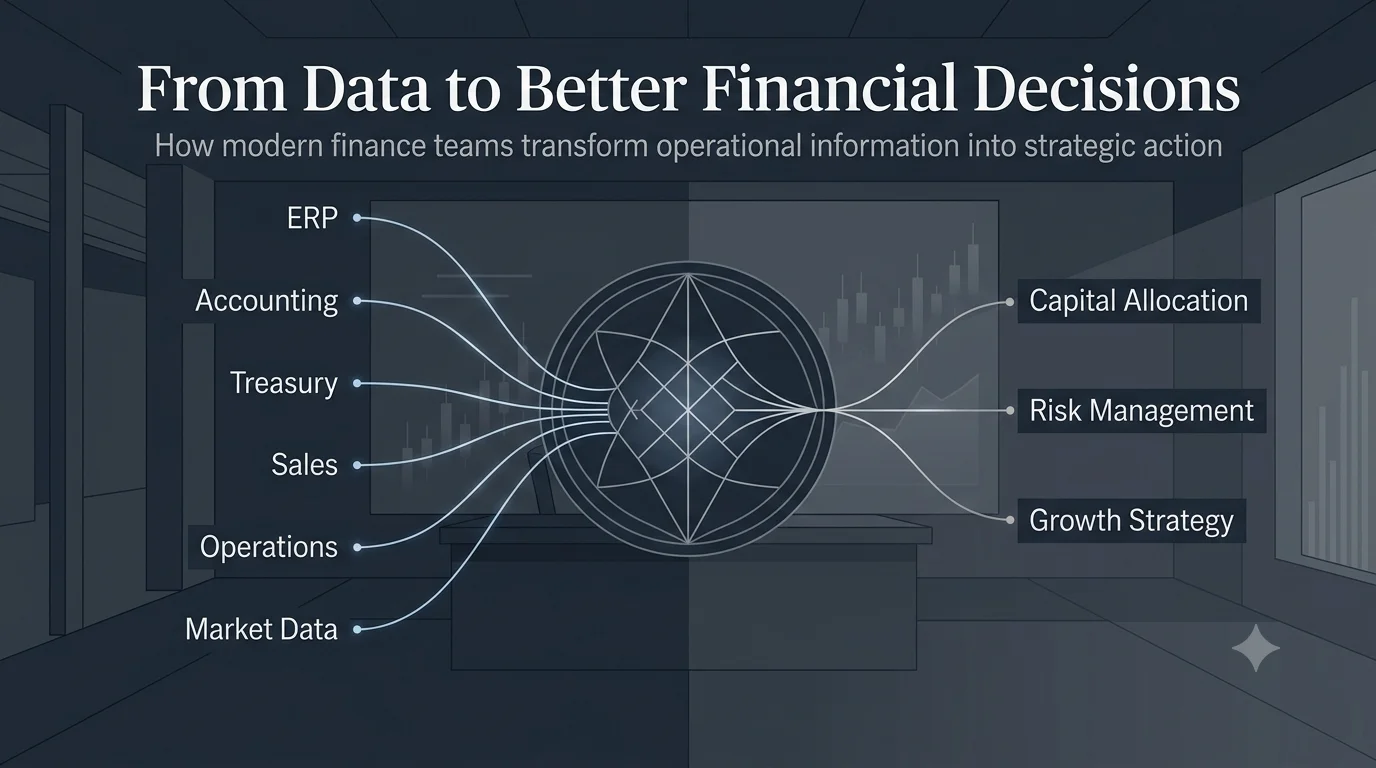
Today, forward-thinking business leaders avoid trailing behind the market by using live dashboards. This is how modern corporate enterprises improve financial health, transforming basic data into a tool for active capital management.
When structured charts become part of the daily routine, finance leaders don’t have to guess—they can actively defend corporate margins as economic pressures shift. Introducing explicit financial decision-making rules lets enterprise leaders empower business units with clear information, meaning cost centres can spot operational friction and exposures long before they hit the bottom line. Anchoring empirical metrics within core workflows is what builds a genuinely durable edge.
What Is Data-Driven Decision-Making in Finance?
At its core, data-driven decision-making in finance simply means anchoring your capital budgets, risk management plans, and corporate goals to solid numbers rather than guesswork. To actually work, this approach requires friction-free access to data across every department, turning dry, rear-view accounting entries into live indicators that guide everyday liquidity and funding choices. For modern financial services companies and international financial institutions, this framework provides an important foundation for capital preservation and sustainable growth.
Understanding the 5 C’s of Data in Finance
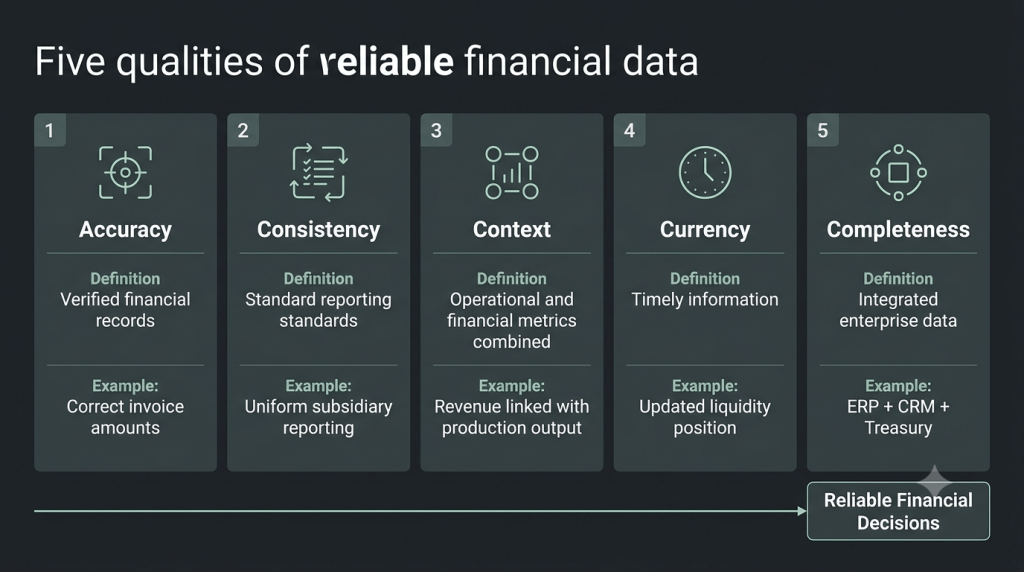
One practical way to assess financial data is to examine five qualities that determine whether it can support reliable analysis:
- Cleanliness (Accuracy): Checking that transactional records reflect the underlying activity and correcting material errors.
- Consistency: Standardising reporting formats across all international subsidiaries.
- Context: Unifying operational variables with core accounting benchmarks.
- Currency: Maintaining sufficiently up-to-date financial data for the decisions being made.
- Completeness: Aggregating comprehensive data from both internal systems and external macro indexes.
What Are the Benefits and Challenges of Data in Finance?
Deploying automated structures helps standardise how an enterprise evaluates its options, effectively dampening the impact of emotion-driven mistakes and cognitive bias.
This isn’t about automating away executive oversight, as the parameters, model designs, and data inputs still require human ownership. What it actually does is introduce a reliable, number-based anchor for the company. By shifting to a central data platform, you phase out erratic, intuition-heavy choices and upgrade the entire framework of business decision-making into something structured and verifiable. This structural adjustment helps control cognitive bias during critical resource reallocation.
Leveraging Tactical Instruments for Corporate Asset Efficiency
Limited data literacy can make it harder for corporate teams to identify underused cash balances or assess their effect on the firm’s return on assets. Treasury teams can address part of this problem through better cash visibility, liquidity forecasts, investment policies, and clearly defined risk limits.
If local rules and company policies allow it, adding CFD trading to the mix can give your team quick, short-term exposure to shifts in FX, commodities, or major indices. It’s definitely not a replacement for traditional cash management—the leverage, margin requirements, and counterparty issues mean you need strict risk management controls. However, when you back these moves with a data-driven approach, using automated exposure caps and hard exit triggers, you can easily keep emotional trades in check while keeping senior analysts firmly in control.
How to Make Better Financial Decisions: A Tactical Blueprint
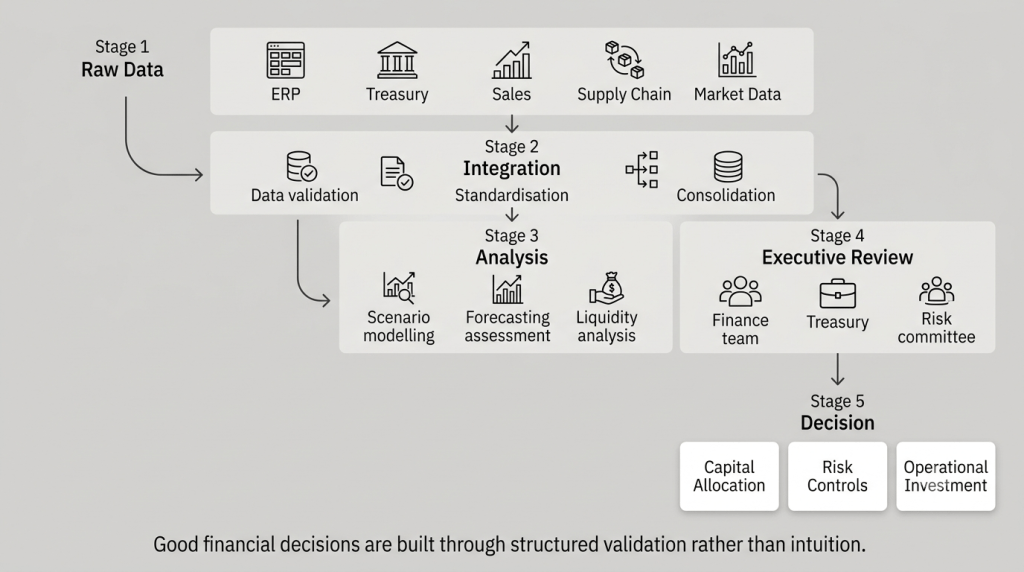
Fixing how to make better financial decisions starts with organizing your data analysis into a clear, four-stage flow. You simply take transactional data collection and process it all the way up to an approved capital or risk management decision. This gives the company a documented evidence base before locking in any financial commitments. It keeps the focus on informed decisions but leaves proper room for shifting liquidity priorities and non-quantifiable business risks.
- Continuous Aggregation: Sourcing raw operational data from all active data sources, supply chains, and banking terminals.
- Automated Integration: Reconciling cross-departmental figures to improve data integration and expose material inconsistencies across the company.
- Scenario Simulation: Utilizing mathematical financial modeling to test liquidity durability.
- Tactical Execution: Allocating corporate funds according to agreed return, liquidity, and risk thresholds to support more informed decisions.
How AI and Machine Learning Enhance Corporate Modeling
Modern strategic planning and financial planning may use quantitative modeling and machine learning to identify patterns in cash flows and support forecasting. Whether these models outperform traditional methods depends on the available data, the forecast horizon, and the stability of the underlying business conditions. Properly trained machine learning models can analyse large datasets much faster than manual review once they have been properly developed and validated.
To execute these complex analytical tasks, financial teams require specialized high-performance digital environments. Using MetaTrader 5 for Windows gives financial teams access to market-depth displays, technical analysis tools, automated strategies, and order-management functions. The quality of pricing, available liquidity, and execution still depends on the connected broker, liquidity provider, and underlying market conditions.
What Tools and Data Types Are Used in Data Analysis?
To get value out of your data analysis, you have to unify macro-level capital metrics with granular operational data. Evaluating a company’s historical data to map out future growth is useful, but historical patterns usually fail to capture sudden disruptions in demand, costs, or market conditions. For true agility, enterprises must bridge the gap between static financial reporting and live customer behavioral data.
Unifying Phocas Financial Statements with Enterprise ERP
Integrating Phocas’ financial statements with existing ERP platforms and operational software creates a unified reporting ecosystem for both financial and non-financial data. This integration allows corporate teams to evaluate organizational financial performance with much greater clarity. As a result, analysts can seamlessly assess baseline financial performance across international subsidiaries, branches, and diverse currency zones.
By reviewing financial results alongside operational key performance indicators, companies can identify rising operating expenses earlier and investigate the business activities behind the change.
This level of operational visibility is easily attainable using Phocas Financial analytics when relevant ERP, accounting, CRM, and operational systems are connected. The platform can consolidate financial information from these sources into a shared reporting environment. More consistent reporting is attainable using Phocas Financial Statements, allowing analysts to examine a branch’s expense ratio, compare results with budgets, and support more reliable forecasting for future quarters.
Before any market strategy is approved, its assumptions, limits, and behaviour under different scenarios should be reviewed and documented. Using a demo trading account is a decent way to get a simulated space where the team can test order logic, position sizes, and how a strategy actually behaves. But let’s be real—it won’t show you real live-market shocks like slippage, sudden liquidity drops, or counterparty issues. It’s a good tool to help make more informed decisions, but it should only back up your main risk assessment and model checks, not replace them.
How to Establish a Resilient Risk Assessment Framework
A comprehensive risk assessment strategy requires the continuous monitoring of a company’s current and future financial health through automated key performance indicators. In volatile macroeconomic environments, passive financial management increases the risk of margin erosion. Corporate sustainability increasingly depends on the active management of liquid assets, credit risk, and counterparty obligations within a unified financial management system.
Advanced Risk Management for Capital Preservation
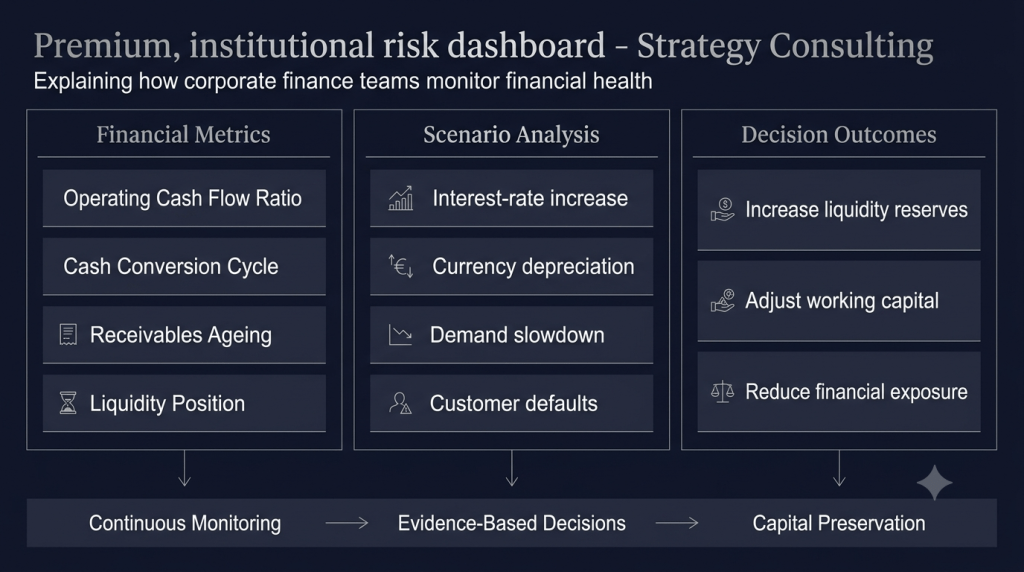
Corporate finance teams use scenario analysis to estimate how exchange-rate movements, interest-rate changes, customer defaults, or demand shocks could affect net income, liquidity, and the company’s ability to meet accounts payable obligations.
When analyzing financial statements, corporate risk officers rely on specific financial metrics to maintain structural stability and enhance decision-making routines:
- Operating Cash Flow Ratio: The relationship between operating cash flow and current liability obligations.
- Cash Conversion Cycle: The time required to convert inventory and other operating inputs back into cash.
- Receivables Ageing: The distribution of outstanding accounts receivable by overdue period, helping teams identify collection delays and rising bad-debt risk.
When internal analytical resources face constraints during major market shifts, corporate treasury desks must look beyond automated retail tools. While copy trading is primarily a retail feature that automatically follows transactions made in another account, corporate finance teams generally use a different process, relying on approved investment mandates, independent advisers, external asset managers, and internally validated benchmarks. Public fund allocations may provide market context, but they can be delayed, incomplete, and poorly matched to a company’s own liquidity needs, so they should not be treated as a substitute for internal risk analysis.
International firms operating across several currency zones may use derivatives to reduce the effect of adverse exchange-rate movements on their gross margin. Where their use is permitted, Forex CFD positions can provide short-term currency exposure without requiring delivery of the underlying currency. They do not guarantee an effective hedge, however, since financing costs, margin requirements, basis risk, counterparty exposure, and mismatched position sizes or maturities can still affect the result.
The Imperative of a Data-First Corporate Culture
Even the best business intelligence tools and financial data in real-time are useless if your teams work in silos or doubt the reports. Managers need basic data literacy to track their specific targets, flag errors, and know the limits of the software. Moving to formal data-driven decision-making means internal debates are settled by facts, not guesswork. This doesn’t eliminate the need for sharp professional judgment, especially when numbers are lean or risks are entirely new.
The priority is simple: integrate financial data with everyday operational pipelines so that advanced data analytics enhance performance across the whole corporate pyramid. When you connect data from accounting, supply chains, and banking terminals, you catch cash flow bottlenecks much faster. Businesses that balance current data with practical operational judgment are simply better at protecting their profit margins when costs or customer demand take a hit.