
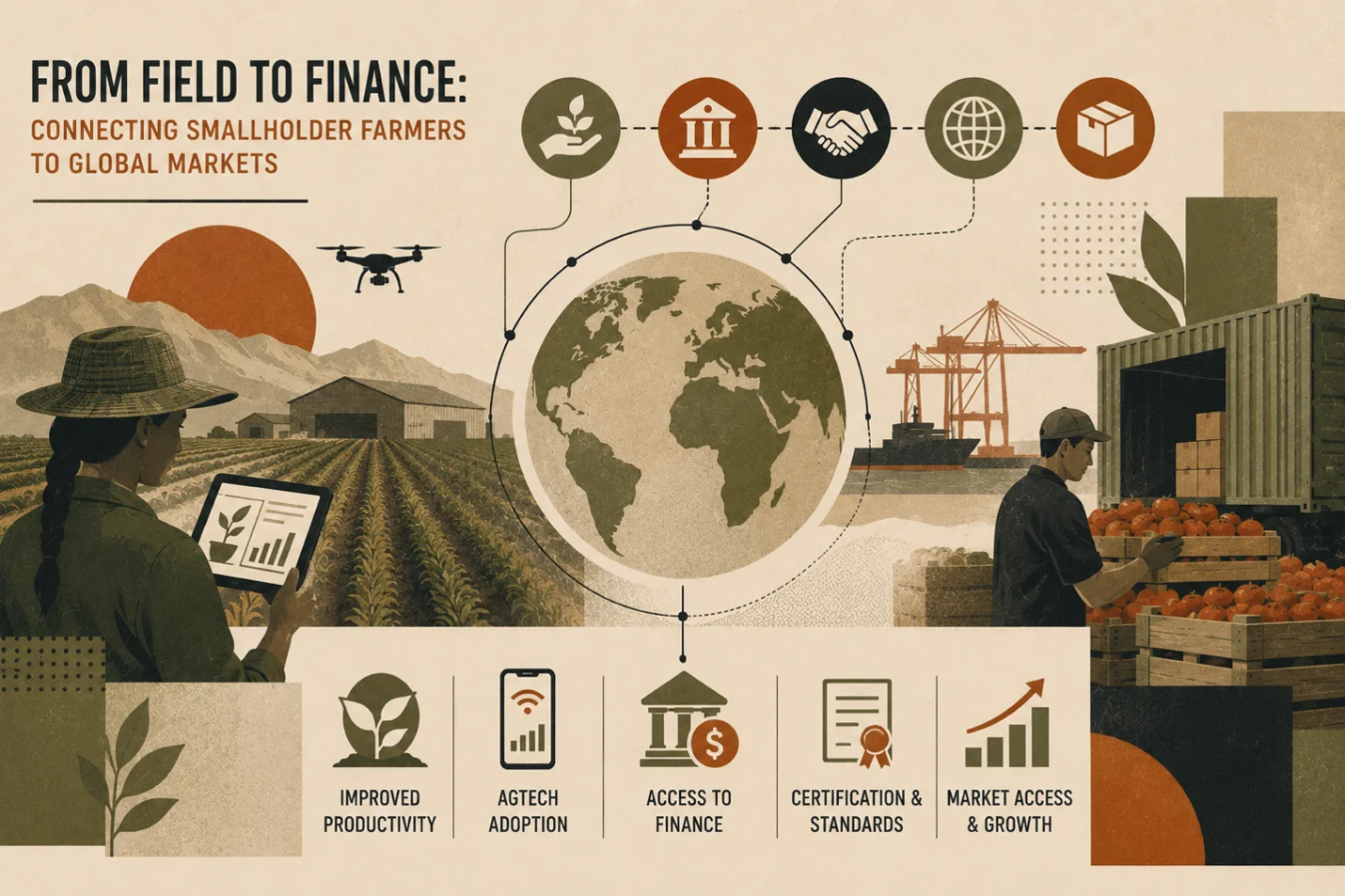
Approximately 570 million smallholder farmers produce more than 70% of the world’s food supply. Most of them can’t access the financing, certifications, or buyer relationships that would let them sell into higher-value markets.
That gap isn’t a productivity problem. Global crop yields per hectare have more than doubled since the 1960s, yet most smallholders still can’t translate that output into higher-value sales. The constraints are structural: post-harvest losses run high without cold chain infrastructure; certification requirements block access to export markets; financial institutions rarely offer products that match seasonal agricultural cash flows; and market information is concentrated among large exporters rather than spread across the smallholder base. A farmer producing quality fruit in Moldova or specialty crops in Georgia may grow produce that meets premium standards without a reliable path to a buyer willing to pay for it.
The Market Access Barriers Facing Smallholder Farmers
Across geographies, many smallholder farmers face similar barriers. Financial institutions generally don’t offer products suited to agricultural cycles: harvest-based repayment, input credit, or seasonal working capital. Certification for international markets (GLOBALG.A.P., organic, or food safety standards) requires investment and technical know-how that most smallholder operations don’t have in-house. Market information (what international buyers want, where to find them, what quality premiums exist) tends to be concentrated among large exporters and unavailable to small producers.
Post-harvest losses make all three harder. A farmer who can’t sell produce to a buyer quickly due to inadequate cold storage or poor road access loses the margin that would have made certification worth pursuing in the first place.
Chemonics’ Approach to Agribusiness Strategy and Growth
Chemonics’ work in agribusiness covers five connected areas: market access and growth, product and productivity improvement, access to finance and investment, AgTech adoption and integration, and sustainability. The work is designed to be end-to-end, because a farmer or agribusiness supported in only one area rarely reaches a different market outcome.
On the finance side, Chemonics designs tailored loan products: harvest-based repayment, digital microloans, and blended finance instruments matched to agricultural cycles. On the technology side, the work includes AI-powered crop diagnostics, drone field mapping, internet-connected field sensors that monitor soil moisture and crop conditions, and blockchain-enabled supply chain traceability. These tools are deployed as integrated components of the business and agronomic support smallholders already receive, rather than handed over as standalone digital products. Partnerships with Cargill and Bayer USA support work on input quality, supply chain standards, and sustainable production practices.
Connecting Georgian Farmers to Buyers Through AgTech
To modernize Georgia’s agriculture sector, Chemonics partnered with the Georgian Farmers’ Association and Adjara Group to build Agronavti: a mobile platform that connects farmers to high-value buyers, provides real-time market and agronomic data, and integrates local product certification. The platform addressed a specific market information asymmetry that kept farmers selling into low-value channels.
The platform facilitated $4.6 million in sales, reached more than 200,000 users, and introduced AI tools supporting smarter on-farm decisions. The direct-to-buyer connections changed price dynamics for participating farmers: with real market intelligence, they could negotiate prices rather than accept whatever they were offered.
Modernizing Moldova’s Agribusinesses for Premium Export Markets
Moldova’s agriculture sector was heavily dependent on Russia and other traditional, low-value export markets. That dependence was exposed sharply when trade embargoes, COVID-19, and the war in Ukraine hit in rapid succession. Moldovan agribusinesses needed to diversify, but access to EU and other premium destinations required certifications, production upgrades, and buyer relationships that most firms hadn’t needed to develop.
Chemonics worked directly with client and partner agribusinesses and producer groups to close those gaps. The results across 458 companies: $201.5 million in domestic and export sales, $44.9 million in new private investment mobilized, and a measurable shift in market composition. In 5 years, EU-bound plum exports rose from 20% of total volume to 58%, 3,649 companies adopted new technologies, 100 reached international certification, and 24 laws and regulations were updated to improve the agricultural business environment.
Women and young people were central to the program’s design. Nearly 3,000 women and more than 3,300 young people received targeted training that opened pathways to agricultural enterprise they hadn’t previously had access to.
Finance as the Foundation for Agribusiness Growth
Market access and certification matter, but smallholder farmers generally can’t pursue either without capital. Financial institutions in rural and lower-income markets face real barriers to serving this population: agricultural income is seasonal, collateral is limited, and the cost of serving small accounts in dispersed geographies is high. Standard bank products don’t fit.
In Colombia, Chemonics worked with banks and financial institutions to redesign the products and service models that make agricultural lending sustainable. The initiative expanded financial access to more than one million rural clients, with nearly half of them women, and unlocked over $1.4 billion in financial services. More than 600 banking access points were established in underserved regions and remained viable after project support ended. The products were designed for the market, not designed for the intervention.
The same principle runs through Chemonics’ agribusiness work globally: tailor financial instruments to agricultural cycles, build institutional capacity in country rather than work around it, and treat market access and finance as interdependent problems. Smallholder farmers produce the majority of the food the world eats. With the surrounding infrastructure in place—financial, logistical, technical, and market-facing—they are well positioned to capture the full value of what they grow, and to keep building on it alongside the institutions and partners that serve them.