
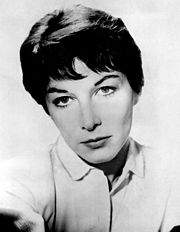
Lee Grant (born Lyova Haskell Rosenthal; October 31, during the mid-1920s)[a] is an American actress, documentarian, and director. She made her film debut in 1951 as a young shoplifter in William Wyler’s Detective Story, co-starring Kirk Douglas and Eleanor Parker. This role earned her an Oscar nomination for Best Supporting Actress as well as winning the Best Actress Award at the 1952 Cannes Film Festival.
In 1952, she was blacklisted from most acting jobs for the next 12 years. Grant was able to find only occasional work onstage or as a teacher during this period. It also contributed to her divorce. During this time, Grant appeared in plays on stage. She was removed from the blacklist in 1963 and started to rebuild her on-screen acting career. She starred in 71 TV episodes of Peyton Place (1965–1966), followed by lead roles in films such as Valley of the Dolls and In the Heat of the Night in 1967, as well as Shampoo (1975), for which she won an Oscar. In 1964, she won the Obie Award for Distinguished Performance by an Actress for her performance in The Maids. During her career she was nominated for the Emmy Award seven times between 1966 and 1993, winning twice.
In 1986 she directed the documentary Down and Out in America which tied for the Academy Award for Best Documentary Feature, and in the same year she also won a Directors Guild of America Award for Nobody’s Child.
Lee Grant Early life
Lee Grant was born Lyova Haskell Rosenthal[1][2] in Manhattan, the only child of Witia (née Haskell), a child care worker, and Abraham W. Rosenthal, a realtor and educator. Her father was born in New York City, to Polish Jewish immigrants, and her mother was a Russian Jewish immigrant.[3] The family resided at 706 Riverside Drive in the Hamilton Heights neighborhood of Manhattan.[citation needed] Her date of birth is October 31, but the year is disputed, with all years ranging from 1925 to 1931 having been given as her year of birth at some point; however, census data, travel manifests, and testimony suggest that she was born in 1925 or 1926, while Grant’s stated ages at the time of her professional debut and Oscar nomination indicate she was born in 1927.[a]
Grant made her stage debut in L’Oracolo at the Metropolitan Opera in 1931[4][5] and later joined the American Ballet as an adolescent.[6] She attended Art Students League of New York, Juilliard School of Music, The High School of Music & Art, and George Washington High School, all in New York City. Grant graduated from high school, and won a scholarship to the Neighborhood Playhouse School of the Theatre, where she studied under Sanford Meisner. Grant undertook further study with Uta Hagen at the HB Studio.[7] She later enrolled in the Actors Studio in New York.
1930s–1950s
Grant had her first stage ballet performance in 1933 at the Metropolitan Opera House.[8] In 1938, in her early teens, she was made a member of the American Ballet under George Balanchine.[8] As an actress, Grant had her professional stage debut as understudy in Oklahoma in 1944. In 1948, she had her Broadway acting debut in Joy to the World. Grant established herself as a dramatic method actress on and off Broadway, earning praise for her first major role as a shoplifter in Detective Story in 1949.[9]
She made her film debut two years later in the 1951 film version (Detective Story), starring Kirk Douglas, receiving her first Academy Award for Best Supporting Actress nomination, and winning the Best Actress Award at the Cannes Film Festival.[10] She said she enjoyed working under director William Wyler, who helped guide her.[11]
But as quickly as that dream unfolded, her life soon turned into a nightmare… So right when her career should have been blooming, she was banned from working in Hollywood. And that ban lasted for twelve years, a lifetime for an actor.
Robert Osborne, Turner Classic Movies interview[12]
In 1951, she gave an impassioned eulogy at the memorial service for actor J. Edward Bromberg, whose early death, she implied, was caused by the stress of being called before the House Un-American Activities Committee (HUAC). Her name soon after appeared in the publication Red Channels, and as a result, for the next twelve years, her “prime years” as she put it,[13] she was blacklisted and her work in television and movies was limited.[14]
Kirk Douglas, who acted with her in Detective Story, recalled that director Edward Dmytryk, a blacklistee, had first named her husband at the HUAC:
Lee was only a kid, a beautiful young girl with extraordinary talent and a big future. You could see it. She was so good that she earned a Best Supporting Actress nomination for her very first film role. But because Eddie Dmytryk named her husband, Lee Grant was blacklisted before her film career even had a chance to begin. Of course, she refused to testify about the man to whom she was married, and it took years before anyone would hire her for another picture.[15]
Grant appeared in a number of plays and in a few small television roles during her blacklisted years. In 1953, she played Rose Peabody in the soap opera Search for Tomorrow. On stage, Grant starred in the Broadway production of Two for the Seesaw in 1959, she succeeded Anne Bancroft in the lead female role.[16] That same year, she had a supporting role in the romantic drama Middle of the Night.
Facebook, Instagram & Twitter
| | Update Soon |
| Update Soon | |
| Update Soon |
Net Worth
The Estimated Net worth is $80K – USD $85k.
| Monthly Income/Salary (approx.) | $80K – $85k USD |
| Net Worth (approx.) | $4 million- $6 million USD |